
Oxytocin 10mg
$55.00
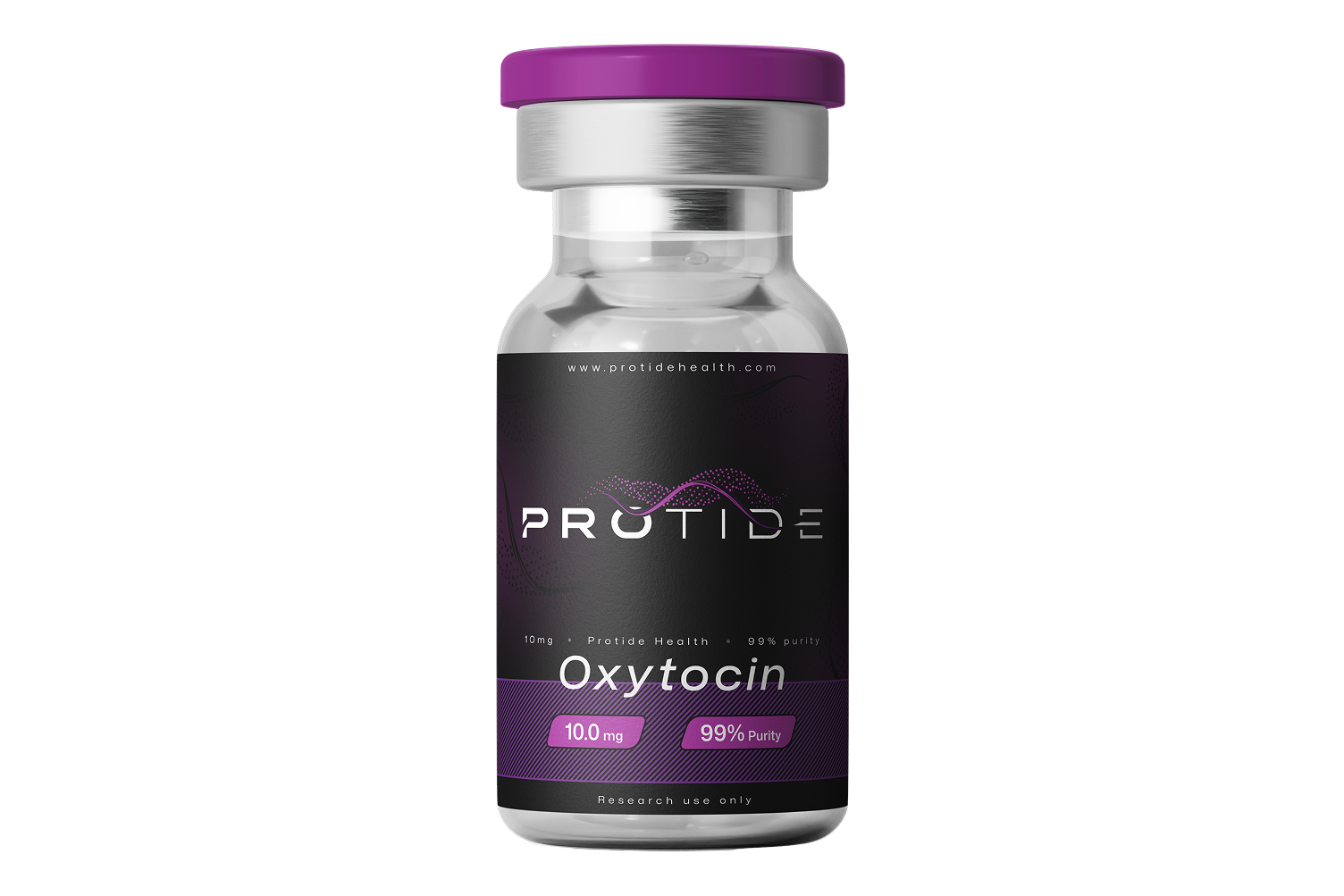
Oxytocin 10mg product shot featuring a professionally labeled Protide Health 3mL research vial containing white to off-white lyophilized oxytocin powder, with the 10mg strength, cyclic nonapeptide identity, and research-use-only labeling clearly displayed against a clean laboratory-style background.


Oxytocin 10mg – Protide Health USA
Oxytocin 10mg Overview & Technical Specifications
Oxytocin 10mg from Protide Health contains synthetic oxytocin supplied as 99% purity lyophilized research material in a 3mL vial.
Oxytocin is a cyclic nonapeptide with the sequence:
Cys-Tyr-Ile-Gln-Asn-Cys-Pro-Leu-Gly-NH₂
A disulfide bond between Cys1 and Cys6 creates the characteristic cyclic portion of the molecule.
The supplied oxytocin PubChem chemical record identifies oxytocin as PubChem CID 439302, CAS 50-56-6, molecular formula C43H66N12O12S2, and molecular weight approximately 1007.2 g/mol.
Protide Health supplies oxytocin 10mg solely for qualified laboratory research involving receptor pharmacology, intracellular signaling, neuroendocrine pathways, molecular interactions, cellular assays, and preclinical models.
Technical Specifications
- Product Name: Oxytocin
- Quantity: 10mg
- Form: Lyophilized powder
- Vial Size: 3mL
- Purity: 99%
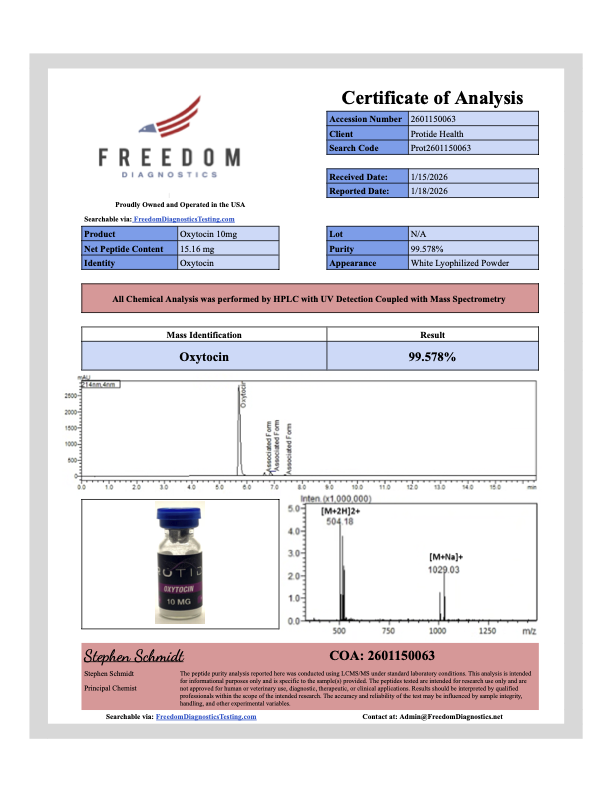
- Testing: HPLC-MS verified; third-party tested
- Peptide Type: Cyclic nonapeptide hormone
- Peptide Length: 9 amino acids
- Sequence: Cys-Tyr-Ile-Gln-Asn-Cys-Pro-Leu-Gly-NH₂
- Disulfide Bridge: Cys1–Cys6
- CAS Number: 50-56-6
- PubChem CID: 439302
- Molecular Formula: C43H66N12O12S2
- Molecular Weight: Approximately 1007.2 g/mol
- Appearance: White to off-white lyophilized powder
- Solubility: Soluble in water
- Storage: Store sealed at ≤6°C and protected from heat, light, and moisture
- Research Use: Receptor, biochemical, neuroendocrine, cellular, analytical, and qualified preclinical research only
Oxytocin 10mg Mechanism & Research Context
The primary molecular target of oxytocin is the oxytocin receptor, or OXTR.
OXTR is a seven-transmembrane G protein-coupled receptor that can engage Gq/11-associated intracellular signaling.
A major signaling pathway involves:
- OXTR binding
- Gq/11 activation
- Phospholipase C activation
- PIP2 cleavage
- IP3 generation
- DAG generation
- Intracellular calcium release
- Protein kinase C activation
- Downstream kinase and transcriptional responses
Additional pathways described in oxytocin receptor research include MAPK, CaMK, PI3K, and Rho-associated signaling.
These mechanisms make oxytocin 10mg relevant to controlled receptor-signaling studies without implying therapeutic use of the Protide Health research vial.
Researchers can review broader oxytocin receptor and neuropeptide research indexed by PubMed for peer-reviewed literature on OXTR signaling, neuroendocrine biology, behavioral models, reproductive physiology, and social-cognition research.
Preclinical Research Applications
Oxytocin Receptor Signaling Research
The oxytocin receptor is the central molecular target for most oxytocin research.
Experimental endpoints may include:
- OXTR binding
- Gq signaling
- PLC activation
- IP3 generation
- DAG signaling
- Intracellular calcium mobilization
- PKC activity
- MAPK signaling
- CREB-associated transcription
- CaMK-associated responses
These pathways provide a mechanistic framework for oxytocin 10mg in biochemical and cell-based research.
Calcium-Signaling Research
Oxytocin receptor activation can increase intracellular calcium through IP3-mediated release from intracellular stores.
Researchers may examine:
- Calcium flux
- Calcium-sensitive enzymes
- Calmodulin signaling
- CaMK activity
- Membrane depolarization
- Voltage-gated calcium channel responses
These endpoints vary by cell type and experimental system.
Neuroendocrine Research
Oxytocin is synthesized physiologically in hypothalamic neurons and is involved in neuroendocrine signaling.
Research areas include:
- Hypothalamic signaling
- Posterior pituitary biology
- Peptide release mechanisms
- Receptor distribution
- Neuroendocrine feedback
- Central versus peripheral oxytocin systems
The Protide Health product is intended for laboratory studies of these pathways rather than clinical administration.
Social-Cognition & Behavioral Research Context
Oxytocin has been extensively studied in behavioral and social-cognition research.
Human and animal studies have examined endpoints involving:
- Social information processing
- Recognition of social stimuli
- Trust-related paradigms
- Social memory
- Anxiety-related responses
- Pair-bonding models
- Maternal behavior
- Context-dependent social behavior
However, human oxytocin research has produced heterogeneous results, and many effects depend on dose, context, sex, study design, baseline characteristics, and route of administration.
Results should therefore not be simplified into claims that oxytocin uniformly improves social behavior.
Oxytocin Nasal Spray Research
The phrase oxytocin nasal spray commonly refers to experimental intranasal oxytocin studies.
Intranasal administration has been used widely in human behavioral research, particularly in studies of social cognition and neurobehavioral responses.
However, the literature has debated:
- How much intranasal oxytocin reaches the central nervous system
- Whether effects result from direct nose-to-brain transport
- Whether peripheral mechanisms contribute
- How spray formulation influences deposition
- How administration methods affect experimental outcomes
- Why behavioral findings vary between studies
The oxytocin 10mg product sold by Protide Health is not supplied or marketed as an oxytocin nasal spray.
No nasal-administration instructions are provided.
Oxytocin Spray Search Terminology
The keyword oxytocin spray generally refers to commercially or experimentally formulated intranasal products.
Protide Health does not represent this lyophilized research material as a nasal spray.
Studies involving formulated intranasal oxytocin should not automatically be applied to an independently supplied lyophilized research vial because formulation, route, concentration, excipients, delivery device, and study conditions differ.
Oxytocin Supplement: Important Classification Note
The phrase oxytocin supplement can be misleading.
Oxytocin is a peptide hormone, not a conventional dietary supplement ingredient.
The Protide Health oxytocin 10mg product is not sold as:
- A dietary supplement
- An oral supplement
- A nasal supplement
- A wellness product
- A pharmaceutical treatment
It is supplied exclusively for laboratory research.
How to Increase Oxytocin: Search Intent vs Research Context
The query how to increase oxytocin usually concerns endogenous human physiology or lifestyle-related questions.
That search intent does not describe the purpose of this product.
The Protide Health research material is intended for controlled scientific investigation of oxytocin and oxytocin-receptor pathways, not for increasing oxytocin levels in people.
No lifestyle, supplementation, dosing, or administration recommendations are provided.
Oxytocin Side Effects & Safety Research
The phrase oxytocin side effects concerns human pharmaceutical or experimental administration.
Clinical oxytocin products have their own approved labeling, dose controls, route specifications, warnings, and safety monitoring.
Separately, controlled intranasal research has examined short-term tolerability in human study settings.
Those observations should not be used to establish a human safety profile for the Protide Health research vial.
Important distinctions include:
- Pharmaceutical oxytocin is formulated and regulated for defined clinical uses.
- Intranasal research formulations vary substantially across studies.
- Laboratory-grade lyophilized material is not equivalent to an approved drug.
- Safety results from one route or formulation do not establish safety for another.
- The Protide Health product has no intended human administration route.
Does Oxytocin Make You Sleepy?
The search does oxytocin make you sleepy reflects interest in interactions between oxytocin signaling and sleep biology.
Research has explored relationships among oxytocin, stress regulation, circadian biology, REM sleep, NREM sleep, social behavior, and hypothalamic signaling.
The evidence is still developing, and these studies do not establish that externally supplied oxytocin reliably causes sleepiness.
The oxytocin 10mg product should therefore not be marketed as a sleep aid or sleep-related treatment.
Oxytocin Structure & Disulfide Research
Oxytocin contains nine amino acids and a disulfide bridge between Cys1 and Cys6.
This cyclic structure is important for:
- Peptide conformation
- Receptor recognition
- Molecular stability
- Structure-activity relationships
- Comparison with vasopressin-family peptides
Because disulfide integrity can affect peptide structure, oxytocin is also relevant to analytical studies involving peptide folding and structural characterization.
Research Format & Storage
Protide Health supplies oxytocin 10mg as white to off-white lyophilized powder in a 3mL vial.
According to the supplied product specifications:
- Store at ≤6°C
- Keep sealed
- Protect from heat
- Protect from direct light
- Protect from moisture
The material is specified as soluble in water.
These are storage specifications for the supplied laboratory product and are not preparation or administration instructions.
Research Limitations
Research involving oxytocin spans molecular biology, neuroendocrinology, animal models, behavioral studies, and regulated clinical use.
Important limitations include:
- Behavioral effects are often context dependent.
- Human intranasal studies have produced mixed and sometimes difficult-to-replicate findings.
- Route of administration can substantially affect interpretation.
- Formulation and delivery device can influence intranasal exposure.
- Peripheral and central mechanisms may contribute differently across experiments.
- Results from approved pharmaceutical preparations do not establish suitability of laboratory research material for human use.
- Animal social-behavior findings cannot automatically be extrapolated to humans.
- Short-term controlled study safety cannot establish general long-term safety.
- Receptor signaling findings do not establish therapeutic efficacy.
These limitations are important for scientifically responsible interpretation of oxytocin research.
Literature & Citation Index
Oxytocin: Crossing the Bridge Between Basic Science and Pharmacotherapy
PMID: 20626426
Research Context: OXTR signaling, Gq/PLC/IP3 pathways, intracellular calcium, PKC, MAPK, and broader oxytocin receptor biology.
The Oxytocin Receptor: From Intracellular Signaling to Behavior
Year: 2018
PMID: 29897293
Research Context: Oxytocin receptor expression, Gq/Gi signaling, intracellular pathways, neuroendocrine functions, and behavioral biology.
A Critical Review of the Influence of Oxytocin Nasal Spray on Social Cognition in Humans
Year: 2012
PMID: 22265852
DOI: 10.1016/j.yhbeh.2012.01.002
Research Context: Intranasal oxytocin and human social-information-processing research.
Intranasal Oxytocin Effects on Social Cognition: A Critique
Year: 2014
PMID: 24239931
DOI: 10.1016/j.brainres.2013.11.008
Research Context: Intranasal delivery mechanisms, central versus peripheral hypotheses, and variability in behavioral findings.
How Can Intranasal Oxytocin Research Be Trusted?
Year: 2020
PMID: 32633663
Research Context: Reproducibility, heterogeneity, statistical power, and limitations in human intranasal oxytocin research.
A Narrative Review on Oxytocin at the Intersection of Sleep, Stress, and Social Behavior
Year: 2026
PMID: 42093825
DOI: 10.3389/fnins.2026.1745281
Research Context: Oxytocin signaling, stress physiology, sleep regulation, social behavior, REM/NREM mechanisms, and neurobehavioral models.
Related Protide Health Research Products
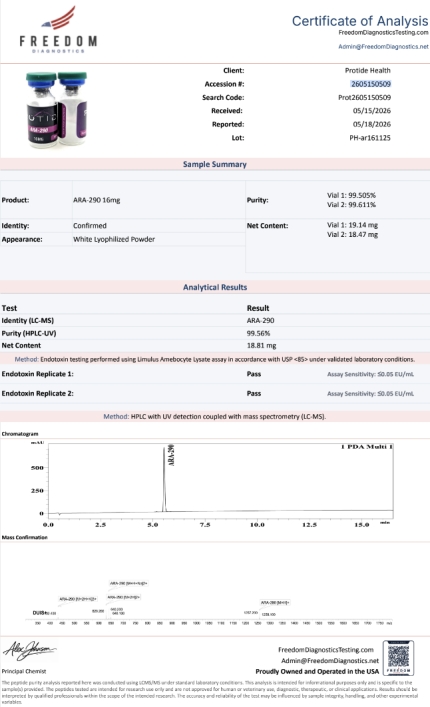
Researchers studying other peptide-signaling systems may review ARA-290 16mg for a structurally and mechanistically distinct research peptide.
The Bacteriostatic Water 0.9% Benzyl Alcohol laboratory product is a separate research-supply item and is not mechanistically related to oxytocin signaling.
Researchers may also examine BPC-157 research peptide for a chemically distinct peptide research system.
These products have different structures, molecular targets, and experimental applications.
Frequently Asked Questions
What is Oxytocin 10mg?
Oxytocin 10mg is a laboratory research product containing 10mg of synthetic cyclic oxytocin peptide in lyophilized form.
What is the oxytocin amino-acid sequence?
The sequence is:
Cys-Tyr-Ile-Gln-Asn-Cys-Pro-Leu-Gly-NH₂
with a disulfide bridge between Cys1 and Cys6.
What receptor does oxytocin bind?
Oxytocin primarily binds the oxytocin receptor, OXTR, a GPCR associated with Gq/PLC/IP3/calcium signaling and additional intracellular pathways.
Is this an oxytocin nasal spray?
No. The Protide Health product is lyophilized laboratory material and is not sold as an oxytocin nasal spray or oxytocin spray.
Is this an oxytocin supplement?
No. Oxytocin is a peptide hormone, and this product is supplied strictly for research rather than dietary supplementation.
What do oxytocin side effects studies show?
Human safety research generally relates to regulated pharmaceutical preparations or controlled experimental formulations. Those findings do not establish a human safety profile for the Protide Health research product.
Does oxytocin make you sleepy?
Research has explored relationships between oxytocin signaling, stress, REM/NREM sleep, and social behavior, but current evidence does not justify marketing oxytocin as a sleep-inducing product.
Is oxytocin FDA approved?
Oxytocin is the active ingredient in FDA-approved prescription products. However, Protide Health oxytocin 10mg is not an FDA-approved drug product and is supplied only for laboratory research.
What purity does Protide Health specify?
The product specification states 99% purity, with HPLC-MS verification and third-party testing.
What form is Oxytocin 10mg supplied in?
Oxytocin 10mg is supplied as white to off-white lyophilized powder in a 3mL vial.
Is Oxytocin 10mg intended for human use?
No. It is supplied exclusively for receptor-binding studies, biochemical analysis, neuroendocrine research, cellular assays, analytical testing, in-vitro studies, and qualified preclinical experimentation.
Laboratory Terms & Compliance
Laboratory Research Use Only
This product is supplied exclusively for laboratory research, analytical testing, in-vitro studies, preclinical research, receptor studies, and qualified scientific experimentation.
It is not intended for human or veterinary consumption, dietary supplementation, medical use, diagnostic use, therapeutic use, nasal administration, injection, reproductive treatment, behavioral treatment, sleep treatment, or clinical administration.
No human dosage, dosing schedule, injection protocol, nasal-spray preparation, administration route, treatment recommendation, or preparation instructions are provided.
The purchaser is responsible for appropriate laboratory handling, storage, and use in accordance with applicable institutional, federal, state, and local requirements.
For research use only.


MAECENAS IACULIS
Vestibulum curae torquent diam diam commodo parturient penatibus nunc dui adipiscing convallis bulum parturient suspendisse parturient a.Parturient in parturient scelerisque nibh lectus quam a natoque adipiscing a vestibulum hendrerit et pharetra fames nunc natoque dui.
ADIPISCING CONVALLIS BULUM
- Vestibulum penatibus nunc dui adipiscing convallis bulum parturient suspendisse.
- Abitur parturient praesent lectus quam a natoque adipiscing a vestibulum hendre.
- Diam parturient dictumst parturient scelerisque nibh lectus.
Scelerisque adipiscing bibendum sem vestibulum et in a a a purus lectus faucibus lobortis tincidunt purus lectus nisl class eros.Condimentum a et ullamcorper dictumst mus et tristique elementum nam inceptos hac parturient scelerisque vestibulum amet elit ut volutpat.
Related products
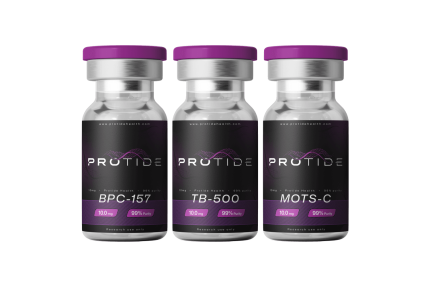
Research Bundle (bpc 157 and tb 500, MOTS-c)
Original price was: $215.00.$205.00Current price is: $205.00.
Reviews
There are no reviews yet.